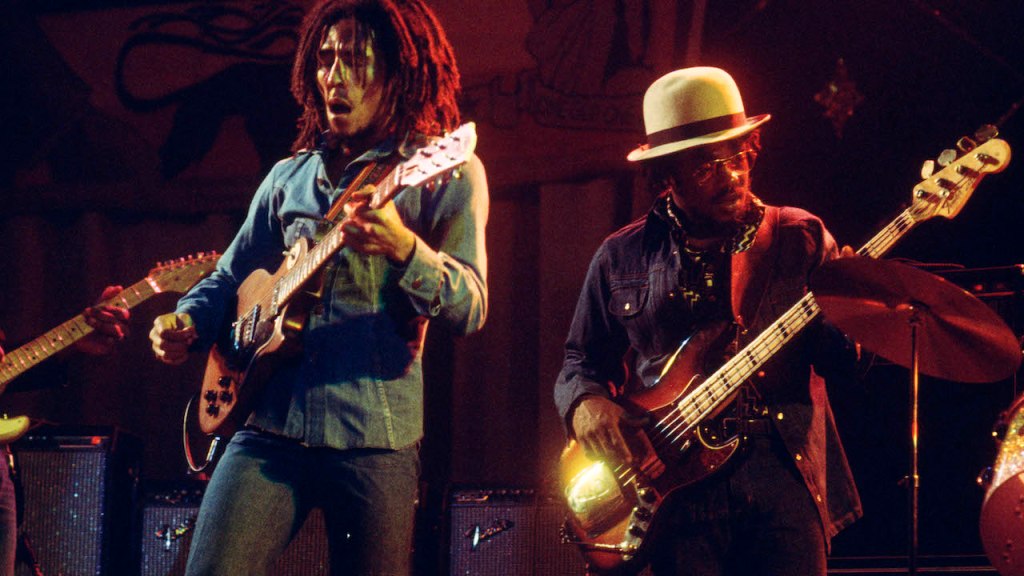
The Wailers are the emperors of reggae music. Hailing (or ‘wailing’) from Kingston, Jamaica, The Wailers became immortalized as the band backing the late Bob Marley, permanently enshrining themselves as the true pioneers of the commercial music of the Rastafari, Caribbean, and black-islander traditions that became so popular worldwide in the 1970s. Recently, the band (performing without Bob Marley since the mid-1980s) stopped in Park City, Utah, for a concert at the Canyons resort, and I attended.
Reggae is a unique style of music. With an increased emphasis on the back-beat and bass line not commonly heard in American pop or rock music, reggae has a way of transporting people to a warmer, brighter, more easy-going frame of mind. The heavy groove underlying light melodies and guitar riffs are easily recognizable to people of all ages and cultures, and The Wailers get it done as good as any. This concert was no exception.
As the performance came to a close, the lead singer of the band had a small boy come on to the stage and join the band between numbers. He introduced the little boy as Peter, a child from Libya who had been born completely deaf. The singer was talking with the interpreter accompanying Peter on stage, and the conversation went something like this:
“So yar tellin’ me dat dis little boy cannot hear any of da music dat we are playin’ here right now?”
“Yes. He can only feel the music inside,” replied the interpreter.
The singer then turned to the audience and said, “Now I want ya all to imagine what it would be like to be barn in a world void of the beautiful sounds of music that we are hearin’ tonight. Imagine dat.”
I have often imagined what it would be like to be deaf, and how challenging that would be (at least having had my hearing already — Peter doesn’t know any different). As I saw the little boy on the stage, I considered my ability to hear as one of my greatest gifts.
Suddenly, the singer grabbed Peter’s hand, placed it on Peter’s chest, and told the bass player to play the groove. As Peter had his hand to his heart, the singer said, interpreted in sign language, “Peter, dis is da bass line.” And he patted Peter’s hand on his chest to the rhythm that the bass player was playing. Peter, now grinning from ear to ear, crouched down, presumably getting closer to the stage floor so he could feel even more of the vibrations from the sub-woofers under the stage. The singer walked Peter over to the bass player’s amplifier on stage and placed his hand in front of it so he could feel the actual air coming through to drivers on the massive 18” speakers he was using. It was particularly impactful to gain a greater understanding of the effect the bass can have on someone, to help someone really feel the music.
The song then started, and while The Wailers played, Peter walked around the stage and began placing his hand over the other amplifiers on stage of the guitarist, the keyboard player, and the horn section. You could tell he was learning how to feel the music, and was thoroughly enjoying it. Peter exited the stage and the band finished their set.
Aside from having the privilege of witnessing a handicapped individual experience the joy of something we unconsciously take for granted, there is another key lesson to be derived on a more spiritual note. That is helping those that are spiritually disabled learn to feel the music of the Gospel, the love of the Savior Jesus Christ, and His role in making our lives easier and more enjoyable.
For example, this principle may be applied in our efforts to share messages of the Gospel of Jesus Christ with our friends and neighbors, in our home and visiting teaching assignments, in teaching our children the basic principles of the Gospel on which our testimonies are built, in fellowshipping less-active members of our wards and branches, and even teaching the active members and believers around us. The Lord as mandated that we “feed [His] sheep,”1 but we can often become discouraged as we contemplate how that can best be done.
Elder Wilford W. Andersen of the Seventy recently expounded on this idea in his April 2015 General Conference address.
“In section 8 of the Doctrine and Covenants, the Lord taught Joseph Smith and Oliver Cowdery, ‘Yea, behold, I will tell you in your mind and in your heart, by the Holy Ghost, which shall come upon you and which shall dwell in your heart’ (verse 2). We learn the dance steps with our minds, but we hear the music with our hearts. The dance steps of the gospel are the things we do; the music of the gospel is the joyful spiritual feeling that comes from the Holy Ghost. It brings a change of heart and is the source of all righteous desires. The dance steps require discipline, but the joy of the dance will be experienced only when we come to hear the music.”2
Just as the singer from The Wailers helped Peter feel the bass line in his heart, so can we help those around us feel the ‘groove’ of the gospel. It is by showing those spiritually deaf how to feel the music so that they can walk across their own stage of life recognizing it and loving it, just like Peter approached the amplifiers on stage. Like the singer had us all imagine life being deaf, what if we all imagined life without the comfort of the Gospel doctrines and Plan of Salvation? Many of us who have “experienced change of heart, and…felt to sing the song of redeeming love…”3 would rather be physically deaf than without our spiritual knowledge. By helping a less active member of the Church feel the love of the Savior, they are feeling within themselves the music — the “peace in this world and eternal life in the world to come.”4 Elder Andersen concluded with the following:
“But when we add music to the dance steps, the sometimes complicated rhythms of marriage and family life tend to move toward a harmonious balance. Even our most difficult challenges will add rich plaintive tones and moving motifs. The doctrines of the priesthood will begin to distill upon our souls as the dews from heaven. The Holy Ghost will be our constant companion, and our scepter—a clear reference to power and influence—will be an unchanging scepter of righteousness and truth. And our dominion will be an everlasting dominion. And without compulsory means it will flow unto us forever and ever (see D&C 121:45–46).”5
The Wailers are all about laying down heavy beats and playing good reggae music. Little did they know that one person in the audience was able to glean a valuable spiritual insight. I am glad I am not deaf. I am glad I can hear the bass lines. I am grateful I have heard the music of the gospel. With the blessing of hearing comes the duty to help others hear it too. Can you feel it? Let’s all reach out so others can feel the bass line.
References
- John 21:16
- Andersen, Wilford W. “The Music of the Gospel.” Ensign, May, 2015, 54.
- Alma 5:26
- Doctrine and Covenants 59:23
- Andersen, 56.
 Dillon Boss