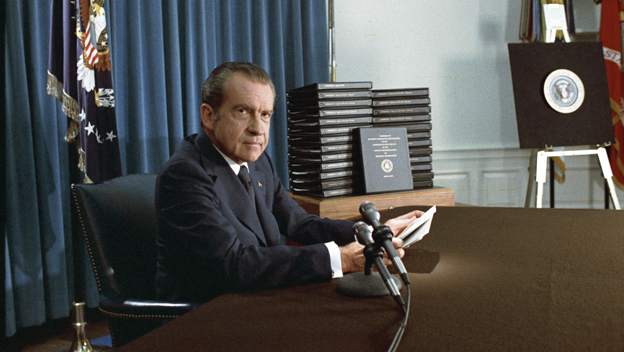
On August 8, 1974, millions of Americans gathered around their radios and television sets to listen to Richard Nixon resign from the presidency of the United States. After many months battling critics, media pundits, party bosses, and Congress over allegations pertaining to what is infamously known as the Watergate scandal, Nixon had decided in the best interest of the country to quit. Facing imminent impeachment and likely removal from office, he left the White House the next day —an abrupt and bitter end to a presidency— to live out his days in obscurity.
Politics aside, the innocence or guilt of Richard Nixon is irrelevant when one simple and profound characteristic is examined, one idea and real accusation made, and that is that President Nixon, at the time, believed himself to be an exception to the rule — exempt from the standard of his appointed office, under which he swore he would abide by faithfully in the presidential oath. And we know that there are no exceptions in the rule of law as constituted by men, at least in the United States of America.
Similarly, we know that there are no exceptions to the rules and commandments of God. When we begin to see ourselves and our behaviors as exceptions to the principles and laws of the gospel, we will find ourselves in a battle. Not necessarily a battle against Congress or major media outlets, but a battle against sin and wickedness, ever capable of leading us down a path of no return directly into the relentless clutches of the adversary. You are not the exception. Only when we commit ourselves to obedience to God and the redeeming grace of the Atonement of Jesus Christ can we be healed, taught, and oriented onto the straight and narrow path directly into the loving embrace of our Heavenly Father.
The scriptures are filled with vivid examples of even the great and noblest of God’s children falling into the terrible trap of making themselves the exception to the laws and commandments they had covenanted to keep. Allow me to profile three as we consider the consequences.
In the Old Testament, we read of King Saul. Saul was a righteous Israelite, a man of God — strong both physically and spiritually. He was a great leader politically and in battle, and the people loved him for it. But things changed when Israel again fell under attack. The kingdom was under great distress, and King Saul needed to take action. He waited for the arrival of Samuel the prophet to make an offering to God in the temple in petition of divine assistance.
8 And [Saul] tarried seven days, according to the set time that Samuel had appointed: but Samuel came not to Gilgal; and the people were scattered from him.
9 And Saul said, ‘Bring hither a burnt offering to me, and peace offerings.’ And he offered the burnt offering.
10 And it came to pass, that as soon as he had made an end of offering the burnt offering, behold, Samuel came; and Saul went out to meet him, that he might salute him.
11 And Samuel said, ‘What hast thou done?’ And Saul said, ‘Because I saw that the people were scattered from me, and that thou camest not within the days appointed….
12 Therefore said I, The Philistines will come down now upon me to Gilgal, and I have not made supplication unto the Lord: I forced myself therefore, and offered a burnt offering.
13 And Samuel said to Saul, ‘Thou hast done foolishly: thou hast not kept the commandment of the Lord thy God, which he commanded thee: for now would the Lord have established thy kingdom upon Israel for ever.
14 But now thy kingdom shall not continue…because thou hast not kept that which the Lord commanded thee.1
In short, we can clearly see that King Saul, the noblest of Israel, decided to make himself an exception to the rule when he performed an ordinance in the temple without proper authority, and he lost everything because of it.
Years later, upon King Saul’s death, David was made king of Israel. We all know David — the stalwart and faithful young warrior. He killed Goliath and won countless other battles for Israel. He was loved, trusted, and protected by the Lord. He became a king of mighty influence and righteousness. However,
2 And it came to pass in an eveningtide, that David arose from off his bed, and walked upon the roof of the king’s house: and from the roof he saw a woman washing herself; and the woman was very beautiful to look upon.
3 And David sent and inquired after the woman. And one said, Is not this Bath-sheba, the daughter of Eliam, the wife of Uriah the Hittite?
4 And David sent messengers, and took her; and she came in unto him, and he lay with her….
5 And the woman conceived….
14 And it came to pass…that David wrote a letter to Joab, and sent it by the hand of Uriah.
15 And he wrote in the letter, saying, Set ye Uriah in the forefront of the hottest battle, and retire ye from him, that he may be smitten, and die.
16 And it came to pass, when Joab observed the city, that he assigned Uriah unto a place where he knew that valiant men were.
17 And the men of the city went out, and fought with Joab: and there fell some of the people of the servants of David; and Uriah the Hittite died also.
27 And…David sent and fetched [Bath-sheba] to his house, and she became his wife, and bare him a son. But the thing that David had done displeased the Lord.2
King David made himself the exception to the commandments of the Lord and spent the rest of his life repenting of his sins. He lusted after Bath-sheba and was responsible for the death of her husband. Because of his moral compromises, he lost the companionship of the Spirit and distanced himself from God, and the kingdom suffered because of it.
As the scriptures continue, King David and Bath-sheba had a son and named him Solomon. Solomon would be king of Israel after his father. It is important to note that despite King David’s mistakes, throughout the remainder of his life he strived to teach young Solomon in the faith and commandments of God. Solomon grew into a righteous man of faith, and he loved God. In our final example, we see that it wasn’t long before King Solomon, once deemed the wisest and greatest in all the world, likewise sought exceptions to the rules.
1 But king Solomon loved many strange women….
2 Of the nations concerning which the Lord said unto the children of Israel, Ye shall not go in to them, neither shall they come in unto you: for surely they will turn away your heart after their gods. Solomon clave unto these in love.
3 And he had seven hundred wives, princesses, and three hundred concubines: and his wives turned away his heart.
6 And Solomon did evil in the sight of the Lord, and went not fully after the Lord, as did David his father.
9 And the Lord was angry with Solomon, because his heart was turned from the Lord God of Israel…
10 And had commanded him concerning this thing, that he should not go after other gods: but he kept not that which the Lord commanded.
11 Wherefore the Lord said unto Solomon, Forasmuch as this is done of thee, and thou hast not kept my covenant and my statutes, which I have commanded thee, I will surely rend the kingdom from thee, and will give it to thy servant.3
King Solomon, following the same pathetic pattern of his predecessors, made himself an exception to the laws and commandments of the Lord, and suffered immensely because of it. Through his wealth and influence, he married women outside his own faith, and it ruined him. He died in shame and thus the kingdom of Israel began its steady descent into apostasy and ultimate destruction.
How often do you find yourselves making exceptions to the rules and commandments of God? Probably too often. I say that because I’ve noticed myself doing it. Too often we say “they” or “them” or “look what that person is like,” “that doesn’t apply to me,” or “I’ve heard this a million times before.” Though the effects of these behaviors often don’t necessarily result in the loss of another life, the destruction of a kingdom, or the damnation of an entire civilization, there are still spiritually damaging consequences that will need to be suffered. Just as making ourselves the exception to local traffic laws might result in an expensive citation, or injurious accident, if me make ourselves the exception to the eternal laws and commandments of God, we risk the same spiritual effects suffered by those great kings of Israel. We lose the ability to understand God. Disobedience is the same no matter who or what you are. You are not the exception.
But after all these biblical examples of rulers making themselves exceptions and falling desperately short of their potential, there is one who never did. Jesus Christ, the Savior of the world, the wisest and most perfect and capable of anyone who ever walked the earth, never let himself become the exception. From his throne at the right hand of the Father, he came to earth. He was baptized by proper Priesthood authority. He suffered pains, afflictions, and temptations of every kind, including those of pride, immorality, greed, and power just like those kings of Israel — even his own ancestry. He was betrayed by his friends. Surely at some point he was physically ill. He was spat upon, ridiculed, and beaten nearly to death. And when the moment came to fulfill his Godly mission and atone for the sins of all humanity, he did so lovingly and willingly for everyone. You are not the exception there either. Because of that, through him and the enabling power of His Atonement, we are able to correct our courses and come back to God. Jesus Christ, in his exact obedience, provided the perfect example of how to live, pray, act, serve, repent, follow, and align our will the Father’s. I bear testimony that Jesus lives. I know that we can be like him. That each of us strives to do so, and that none of us make ourselves the exception, is my prayer, in the name of Jesus Christ, amen.
References
- 1 Samuel 13:8-14
- 2 Samuel 11:2-5, 14-17, 27
- 1 Kings 11:1-3, 6, 9-11
 Dillon Boss