This post was originally published on March 8, 2016
As I ponder the marvels of human achievement, there are several events that come to my mind. Among many things, I think of the construction of the pyramids, the proliferation of literature from the printing press, the discovery of the New World, the Constitution of the United States of America, the invention of the light bulb, the airplane, and even feats of heart like the ‘Miracle on Ice.’ Though advancements of useful technologies emerge now at what seems like a daily cadence, there was a pinnacle series of explorations that to me merit the highest of recognition: When human beings broke the bonds of the atmosphere and ventured into the unknowns of space.
I am not a scientist nor an engineer and certainly do not claim anything more than a rudimentary understanding of science and technology. Others might be able to outline specific innovations that carried men to the moon even down to the very elements and compounds that makeup each drop of a fuel or composite. All I know is that there were gifted people, men and women alike, whose minds were illuminated and driven by something far greater than what I have and probably will ever experience. From the conception (and controlled execution) of propelled flight on the sands of Kitty Hawk to the experiences of veteran military aviators of the modern age —even astronauts— propelling themselves into infinity and beyond on a multi-billion dollar rocket-boosted marvel, it is not hard to recognize the greatness of human ingenuity and the explorer spirit that lives somewhere within us all.
As the United States gained momentum with the Gemini rocket program in the mid-1960s, it became clear that we were on track not only to walk on the moon, but return home to tell about it. That, however, needed to be executed in several intricately planned stages. Each Gemini and subsequent Apollo mission was designed to push farther than the last, testing small parts of a greater whole. First, it was simply launching someone into the stratosphere. Then, another into orbit. Then several orbits. Then they went to the moon if only for a ‘fly by.’ Then, they had the challenge of deploying a manned craft to the moon, launching it again, and somehow docking it back to the mother ship in orbit and come back safely to the confines of earth’s gravity. It sounds totally and completely impossible, but that is how it was to be done. You can watch countless documentaries about this process (even conspiracy theories) and learn a lot, but one particular mission (pre-Apollo 11) struck me more than others.
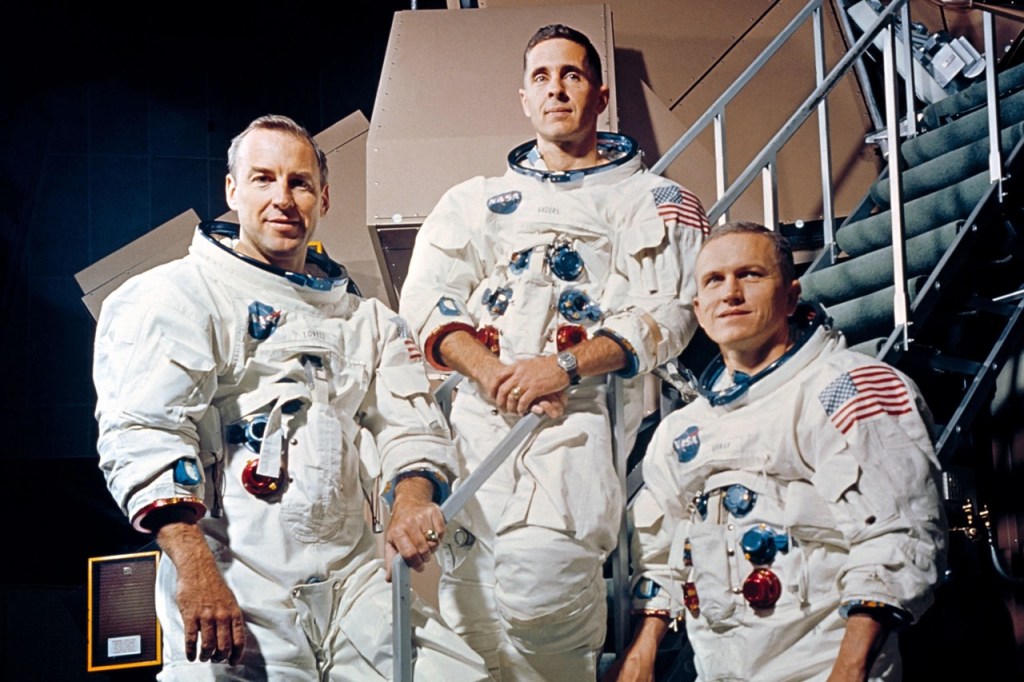
On December 21, 1968, Frank Borman, Jim Lovell, and Bill Anders launched from Cape Canaveral, Florida as the crew of Apollo 8 and became the first men to leave Earth’s low orbit en route to the moon. They were the first set of human eyes to see our planet as a whole, as a totally spherical object — a delicate ornament in an infinite firmament of nothingness.
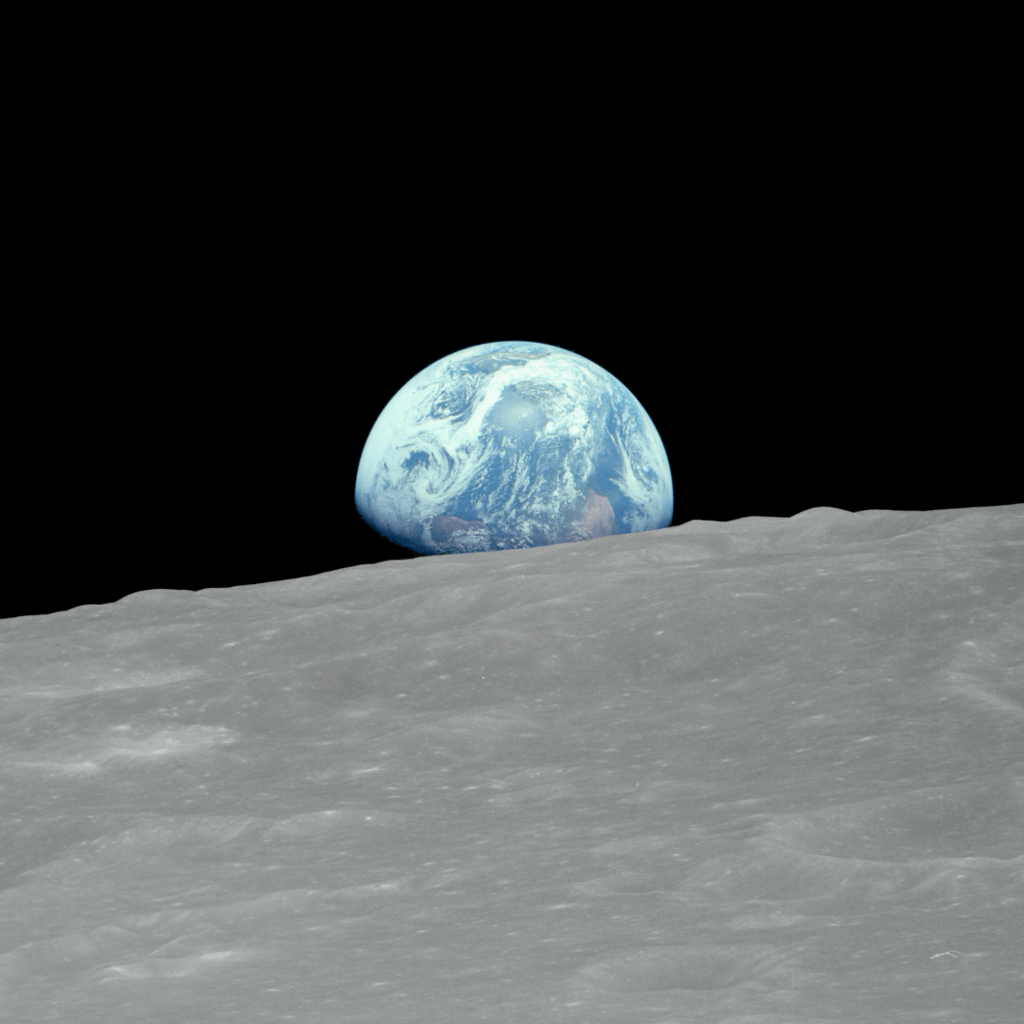
Three days they travelled to ultimately orbit the moon ten times on Christmas Eve. And while tens of millions of people watched the event back home and around the world, those three men took the opportunity to do something that unfortunately in the present day would be considered politically unconscionable — especially coming from a publicly funded project such as Gemini. With the attention of the masses of the world hanging on every word, American astronaut Frank Borman chose to communicate the following message via radio transmission:
“We are now approaching lunar sunrise, and for all the people back on earth, the crew of Apollo 8 has a message that we would like to send to you” he said.
The crew members then took turns reading these eternally prolific verses as recorded in the Bible in the first chapter of Genesis:
1 In the beginning God created the heaven and the earth.
2 And the earth was without form, and void; and darkness was upon the face of the deep. And the Spirit of God moved upon the face of the waters.
3 And God said, Let there be light: and there was light.
4 And God saw the light, that it was good: and God divided the light from the darkness.
5 And God called the light Day, and the darkness he called Night. And the evening and the morning were the first day.
6 And God said, Let there be a firmament in the midst of the waters, and let it divide the waters from the waters.
7 And God made the firmament, and divided the waters which were under the firmament from the waters which were above the firmament: and it was so.
8 And God called the firmament Heaven. And the evening and the morning were the second bday.
9 And God said, Let the waters under the heaven be gathered together unto one place, and let the dry land appear: and it was so.
10 And God called the dry land Earth; and the gathering together of the waters called he Seas: and God saw that it was good.1
Borman then closed the transmission with “…And from the crew of Apollo 8 we close with good night, good luck, a merry Christmas, and God bless all of you, all of you on the good earth.”
Before long, the crew splashed grandiosely into the north Pacific Ocean on December 27th. They became TIME Magazine’s “Men of the Year.”
I feel justified when I say that modern demonstrations of faith are not received the same as they were just 47 years ago. Society has shifted to an extreme polarity where demonstrating faith in God, expressing ones beliefs openly, inviting others to believe, or quoting bible verses has become taboo or in some circles even ‘hate speech’ toward those unsympathetic. But those men, the astronauts of Apollo 8, knew that despite the greatest of all human accomplishments for which at the time they were congratulated, the true greatness and glory belonged only to God and His Son Jesus Christ, who in Their divine partnership “created the heavens and the earth, and all things that in them are.”2
Imagine you have the rare opportunity to address the entire world at once. What would you say? What would you deem most important that every nation, kindred, tongue, and people should hear it? With the whole world in their hands, the words these astronauts chose to share were not their own, but those of God. I believe that as humans venture into the vastness of science and discovery, the only true constant worth depending on is the omniscience of the Almighty and His infinite capacity to create for us. The message of Frank Borman, Jim Lovell, and Bill Anders that night nearly 240,000 miles away from earth was nothing short of a testimony of Him, and “the nothingness of the children of men….”3 that the people of our world would be keen to remind themselves of. I am honored that such men put God first. It is an example to us all.
References
- Genesis 1:1-10
- 3 Nephi 9:15
- Helaman 12:7
 Dillon Boss