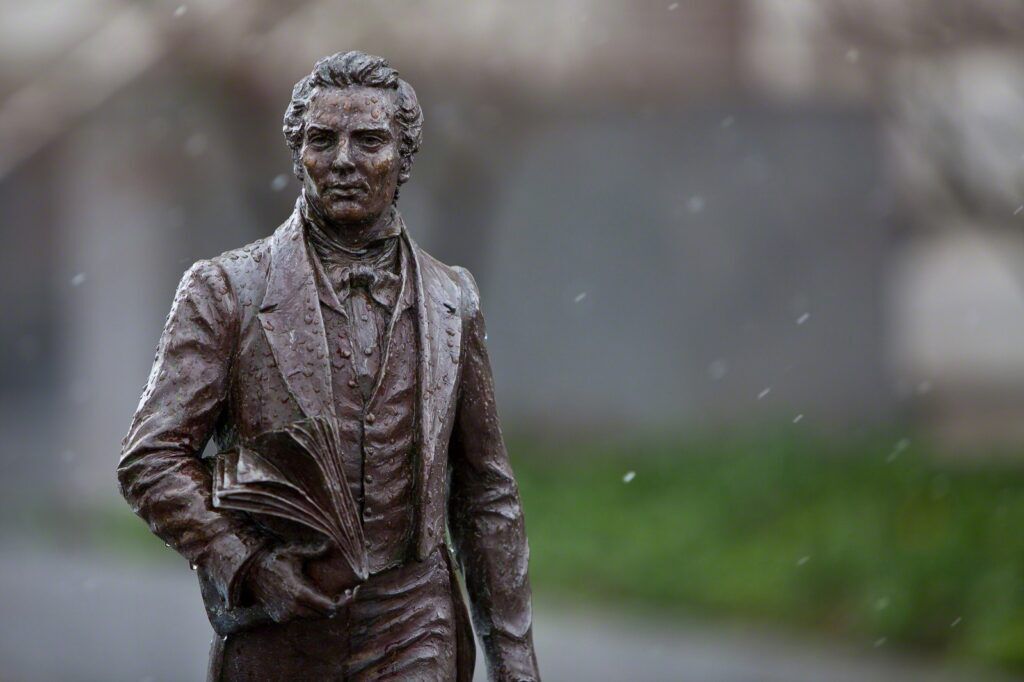
Joseph Smith said that when he was seventeen years old, an angel told him that his “name should be had for good and evil among all nations, kindreds, and tongues, or that it should be both good and evil spoken of among all people.”1 “This amazing prophecy,” said Elder Lawrence Corbridge of the Seventy, “is continuing to be fulfilled today as The Church of Jesus Christ of Latter-day Saints has spread throughout the world.”2
In 1842, Joseph wrote to John Wentworth, editor of the Chicago Democrat:
“Our missionaries are going forth to different nations, and in Germany, Palestine, New Holland, Australia, the East Indies, and other places, the Standard of Truth has been erected; no unhallowed hand can stop the work from progressing; persecutions may rage, mobs may combine, armies may assemble, calumny may defame, but the truth of God will go forth boldly, nobly, and independent, till it has penetrated every continent, visited every clime, swept every country, and sounded in every ear; till the purposes of God shall be accomplished, and the Great Jehovah shall say the work is done.”3
Just as it is easy and inspiring to recognize the fulfillment of the prophecies regarding the spreading of the restored gospel of Jesus Christ and the prophet’s name being had for good in these latter days, it is likewise easy to recognize the prophet’s name being had for evil. I would go as far as to say that the time we live in now is the only time that rivals when the prophet was alive in two major ways. The first is that never in the history of the restored Church since its founding has there been more revelation progress in Church programs and policies, and second, never in the history of the restored Church since its founding has the prophet Joseph Smith been so aggressively antagonized. The fact of the matter is that we live in challenging times, and as the Church has taken a more prominent position in the American religionscape and more broadly in global Christianity, being a member of the Church of Jesus Christ of Latter-day Saints and defending the “Standard of Truth” has become trickier; not necessarily more difficult, after all, most of us are not actively persecuted, driven from our homes, or physically assaulted like our pioneer forbears, but it has certainly become more delicate.
I also need to stress that in my opinion, it has become totally trite and cliché to begin any sort of remarks by professing that ‘we live in challenging times’ or ‘we live in a period of unprecedented difficulty.’ Though it is true that life is challenging, and that the world is a difficult place to navigate, it has always been that way. If we really think about the level of challenges and difficulties we face today in relation to the level of knowledge and resources we have today, it really is not that bad, and in no way can anyone convincingly argue that we are in any way unique from those that have gone before us. It is an historical trend as well as a doctrinal one that our Heavenly Father, through modern prophets, always provides the tools and knowledge we need to confront the trials of our day, and if we don’t, we are inspired and given the necessary means to obtain them. I understand that this is a bold claim that might rub some people the wrong way, but allow me to briefly offer some context for further clarification. Bear with me and know that there is a point to what I’m about to say.
For example, notice the patterns as we consider in parallel the innovations in our standard of living in the United States in the last 150 years or so, and the direct relationship between human needs and the development of technology. As living and working became more and more complex as history progressed moving people and families from farms and small towns to factories and big cities, we see the invention of electricity and the telegraph. As fewer farmers were required to produce more food for more people, farming equipment became bigger, faster, and stronger. We experienced the mass production of automobiles, the faster delivery of mail, indoor plumbing and related improvements in hygiene, telephones, radio, air travel; public health concerns brought innovation in medicine, hospitals, and healthcare; and moving further into the twentieth century, computers, word processors, the internet — the list could go on and on. My point is that as the challenges and difficulties and wickedness of the world and living in it have increased, we are committing a terrible error if we think that the resources available for us to combat it have not increased as well. Because they have. More importantly than any of the examples mentioned above, never before in the history of the world have we enjoyed as much spiritual revelation, inspiration, teaching, guidance, counsel, insight, and uplifting content as we do now in staggering quantities, and never before has it been as accessible and easy to find, use, and enjoy at any hour of the day on any kind of device at 250 megabits per second as it is now. Interestingly, the same can be said about the accessibility, quantity, and pervasiveness of the evils of pornography and harmful substances. So there is a relationship here, and it is one that prophets have always foreseen and one that God has always prepared us for. We just need to recognize it. I want to make sure this point is well understood as I further discuss the prophet Joseph Smith and his position in the world today.
People both in and outside of the Church have been experiencing difficulties understanding the life of the Prophet, and some of you may have experienced or might even currently be experiencing a lapse in faith or big questions that you find are not easy to answer regarding Joseph Smith or things that have happened throughout the history of the Church. The internet is filled with endless pages of blogs, forums, posts, narratives, opinions, videos, rants, raves, and interpretations of Joseph Smith’s teachings, behaviors, and actions on the historical record that offer unflattering and offensive depictions of events from his life, some very much true, but many of them embellished, decontextualized, or total fiction. At the same time, however, there are seemingly numberless pages of material published officially by the Church and other reputable sources both academic and non-academic that offer grounded, well-researched, and well-cited historical and doctrinal insights that make as much sense if not more sense than the antagonizing narratives offered by enemies of the Church.
All of us have been witnesses recently to a new wave of transparency in the depiction and understanding of Church history, especially in the last five years. Questions ranging from history to doctrine to politics have entered colloquial conversations that were never considered until relatively recently. And like I suggested prior, so too have answers and information. Take the publication of The Family: A Proclamation to the World in 1995, for example, which came as a much needed and timely resource for navigating the troubles of twenty-first century social politics and has carved a place in the Latter-day Saint vernacular second only to canonized scripture. In 2014, the Church officially published a video explaining in detail the temple garment and other sacred and ceremonial clothing used in the temple. Official images and explanations of Joseph and Oliver Cowdery’s process of translating the Book of Mormon with a seer stone are now available. A collection of Gospel Topics Essays is available in the Gospel Library that address a number of important “hot” topics that until recently were not available and even considered taboo. Even in recent weeks, information about the use of sacred tithing funds and the Church’s financial reserves has been made available to the public. Especially relevant to my topic today is the Joseph Smith Papers project, which, when completed, will offer a comprehensive narration and publication of every collection of documents in the Church’s legal possession either in printed books or online. Thousands of man hours worked by highly trained research and editorial professionals financed by millions of generously donated dollars are spent in an effort to provide the public with this resource, offering not just a window into the Prophet’s life and ministry, but an open door. I could go on and on of course, but for the sake of time this list will have to suffice to illustrate my point.
Some of you may be thinking or might have at one time thought, in the company of dissidents and other critics of the Church, that such information is only provided in response to attacks, whistleblowers, media inquiries, complaints, protests, or other worldly taunts. In many cases, they are. But to them I say so were toilets and Tylenol. So were iPhones and ice cube trays. When considering the dissemination of information and content, remember this: Nothing of value —no information or successful product— was ever provided or sold to the public that didn’t first answer a question, respond to outcry (whether positive or negative), or satisfy a need or niche. So what does all this mean as we approach the study of the life of Joseph Smith and the history of the Church? In the early twentieth century, the world was ready for cheap automobiles, so we made them. In the 1960s, the world was ready to explore space, so we went. In the spring of 1820, the world was ready for the restored gospel of Jesus Christ, so God the Father and His Son Jesus Christ restored it. Now, at the close of the 2010s, the world is ready to know more truth, so we are getting it. I testify that Heavenly Father and Jesus Christ have a hand in all of this for and according to their divine purposes for us. I invite everyone to pay attention to what is written in John 8:32 when it says that “[we] shall know the truth and the truth shall make [us] free.”4 We truly are being made free.
But for some reason, some are not being made free. Some of us, perhaps some people here today, and at certain times myself, do not experience the promise that wisdom will be given liberally an unupbraided if we ask of God, as Joseph read in James.5 Sometimes in our efforts to find that wisdom and know the truth, we might become disillusioned, confused, upset, or grow tired. Some end up leaving the Church altogether, reinforcing the adage Brother Glenn Pace, then in the Presiding Bishopric of the Church, spoke of in the April 1989 General Conference:
“It seems that history continues to teach us: You can leave the Church, but you can’t leave it alone. The basic reason for this is simple. Once someone has received a witness of the Spirit and accepted it, he leaves neutral ground. One loses his testimony only by listening to the promptings of the evil one, and Satan’s goal is not complete when a person leaves the Church, but when he comes out in open rebellion against it.”6
So, having already established that the world is full of these types of voices whose reach and volume seem to be increasing, what measures are we to take to strengthen and secure ourselves? How can we come to know and cling to the truth? How do we learn the truth the way our Heavenly Father wants us to learn it? History offers no finer example of this struggle and what we can do to endure it than from the life of the Prophet Joseph Smith himself. I invite you to learn from him as I read from his history:
“Owing to the many reports which have been put in circulation by evil-disposed and designing persons, in relation to the rise and progress of The Church of Jesus Christ of Latter-day Saints, all of which have been designed by the authors thereof to militate against its character as a Church and its progress in the world—I have been induced to write this history, to disabuse the public mind, and put all inquirers after truth in possession of the facts, as they have transpired, in relation both to myself and the Church, so far as I have such facts in my possession.
“Some time in the second year after our removal to Manchester, there was in the place where we lived an unusual excitement on the subject of religion. It commenced with the Methodists, but soon became general among all the sects in that region of country. Indeed, the whole district of country seemed affected by it, and great multitudes united themselves to the different religious parties, which created no small stir and division amongst the people, some crying, “Lo, here!” and others, “Lo, there!” Some were contending for the Methodist faith, some for the Presbyterian, and some for the Baptist.
“For, notwithstanding the great love which the converts to these different faiths expressed at the time of their conversion, and the great zeal manifested by the respective clergy, who were active in getting up and promoting this extraordinary scene of religious feeling, in order to have everybody converted, as they were pleased to call it, let them join what sect they pleased; yet when the converts began to file off, some to one party and some to another, it was seen that the seemingly good feelings of both the priests and the converts were more pretended than real; for a scene of great confusion and bad feeling ensued — priest contending against priest, and convert against convert; so that all their good feelings one for another, if they ever had any, were entirely lost in a strife of words and a contest about opinions.
“During this time of great excitement my mind was called up to serious reflection and great uneasiness; but though my feelings were deep and often poignant, still I kept myself aloof from all these parties, though I attended their several meetings as often as occasion would permit. In process of time my mind became somewhat partial to the Methodist sect, and I felt some desire to be united with them; but so great were the confusion and strife among the different denominations, that it was impossible for a person young as I was, and so unacquainted with men and things, to come to any certain conclusion who was right and who was wrong.
“My mind at times was greatly excited, the cry and tumult were so great and incessant. The Presbyterians were most decided against the Baptists and Methodists, and used all the powers of both reason and sophistry to prove their errors, or, at least, to make the people think they were in error. On the other hand, the Baptists and Methodists in their turn were equally zealous in endeavoring to establish their own tenets and disprove all others.
“In the midst of this war of words and tumult of opinions, I often said to myself: What is to be done? Who of all these parties are right; or, are they all wrong together? If any one of them be right, which is it, and how shall I know it?
“At length I came to the conclusion that I must either remain in darkness and confusion, or else I must do as James directs, that is, ask of God. I at length came to the determination to “ask of God,” concluding that if he gave wisdom to them that lacked wisdom, and would give liberally, and not upbraid, I might venture.
“So, in accordance with this, my determination to ask of God, I retired to the woods to make the attempt. It was on the morning of a beautiful, clear day, early in the spring of eighteen hundred and twenty. It was the first time in my life that I had made such an attempt, for amidst all my anxieties I had never as yet made the attempt to pray vocally.
“After I had retired to the place where I had previously designed to go, having looked around me, and finding myself alone, I kneeled down and began to offer up the desires of my heart to God. I had scarcely done so, when immediately I was seized upon by some power which entirely overcame me, and had such an astonishing influence over me as to bind my tongue so that I could not speak. Thick darkness gathered around me, and it seemed to me for a time as if I were doomed to sudden destruction.
“But, exerting all my powers to call upon God to deliver me out of the power of this enemy which had seized upon me, and at the very moment when I was ready to sink into despair and abandon myself to destruction—not to an imaginary ruin, but to the power of some actual being from the unseen world, who had such marvelous power as I had never before felt in any being—just at this moment of great alarm, I saw a pillar of light exactly over my head, above the brightness of the sun, which descended gradually until it fell upon me.
“It no sooner appeared than I found myself delivered from the enemy which held me bound. When the light rested upon me I saw two Personages, whose brightness and glory defy all description, standing above me in the air. One of them spake unto me, calling me by name and said, pointing to the other—This is My Beloved Son. Hear Him!“7
I testify that this happened as the prophet described in this and in at least eight other different accounts. Though they naturally and understandably differ in specific details, think about them not as inconsistent historical accounts made at different points in Joseph’s life, which in some cases they are, as any story told over time by any human being becomes; but instead think of Joseph’s accounts as unanimously and consistently conveying the same struggle of confusion, the agony of temptation, and the miracle of divine deliverance. Joseph Smith was made free by the truth that spring morning. The doctrinal truths revealed that morning foremost, but the mortal, existential truths as well — those of struggle, agony, and deliverance. This is the truth. And though it is safe to say that all of us will go about our earthly experience never experiencing a theophany like young Joseph’s, we can use his experience as a model and framework for our own path of discovery, testimony, and divine seeking. If there is nothing else we can learn from the life of the prophet Joseph Smith, it is that we too can know the truth if we knock. Anyone can. And millions and millions of people have.
But the First Vision wasn’t the end of the story. Often times when I have the chance to talk to people about my experience working on the Joseph Smith Papers project, the main question I am often asked is what the most shocking thing I learned was. I kindly joke that I am beyond shock and that nothing surprises me anymore, and then I always try to reframe the question to focus on the most meaningful and important things I learned that strengthened my testimony of the Restoration. I tell them that the man Joseph Smith and the Prophet Joseph Smith are the same person, and that is totally okay. Joseph was more like the rest of us than most of us think. But that isn’t always intuitive for some people. In a steep culture of hero worship as a people in general and especially as members of the Church, it can be challenging and uncomfortable to humanize God’s servants. Oftentimes it feels more helpful and secure to us to esteem them beyond their own humanity, beyond reverence and respect for their callings and instead setting unhealthy and less-than-helpful standards that no mortal can reasonably achieve. No one is particularly to blame for this, but it would do us all some good to consider the following observation.
Missionaries throughout the world are responsible for the proliferation of a 30-minute DVD presentation of the life of the Prophet Joseph Smith. There is likewise a full-length feature presentation of the prophet’s life called Joseph Smith: Prophet of the Restoration. Those of us that served missions in the last decade might remember fondly many a family home evening spent gathered around with member families and investigators watching this film, which in many ways unfairly portrays Joseph and his mission. Now, don’t get me wrong, the Church spent a lot of money on that presentation and I enjoy it, but like I mentioned before, Joseph Smith was a man, and whereas the film portrays the prophet going about restoring the Church and the Priesthood, building temples, going gayly from place to place teaching and baptizing and blessing and effectuating miracles of healing with the occasional insult and tar and feathering, which are all documented historical events, the other, more increasingly relevant truth of the matter is that many years separated most of those events and the majority of those years were spent in stupor, confusion, immense stress, anxiety, fear, impending bankruptcy, and even depression and anxiety to the point of feeling totally abandoned by the same God and Savior that had at one time stood above him in brightness and glory. Indeed, following that first vision in the spring of 1820, Joseph spent the remainder of his years chasing Heavenly Father, most of the time only to be met with silence. I want everyone to know, if you do not already know it, that Joseph Smith, the inspired and enlightened prophet that he was, was also a profoundly lonely and tormented man, more acquainted and experienced in trial, loss, and spiritual and physical pain and fear and even death than most of us will ever know. Sometimes I don’t think the movie we show the world is totally accurate in that regard, but perhaps it doesn’t have to be. I don’t know.
Another question I am often asked when discussing my experience researching Joseph Smith and the early Church is this: Having read and seen and known so much, how am I still active in the Church? When so many other people who experience trials of faith after learning something questionable about Joseph Smith from some forum online, how am I still here having spent time in the actual historical record? I always chuckle inside at this one, because a few years ago I found myself wanting to ask the same question to one of my cousins, who happens to be Dean Jessee, one of the Church’s foremost historians of the life of Joseph Smith and the founding editor of the Joseph Smith Papers project. Richard Bushman’s seminal biography of the prophet titled Rough Stone Rolling, which I encourage any and all to purchase and read, is even dedicated to him. Anyway, I had an interesting experience with him that laid the groundwork for my involvement with the project a few years later, and also completely elevated my pattern of thinking about Joseph Smith, his mission, his critics, and our responsibility to him as members of the Church.
My father had invited me to come along with him to a special family home evening activity that my grandparents were hosting at their home in Taylorsville, Utah. My grandfather, who happens to be Dean Jessee’s uncle, had invited Dean to come and speak to a group of ’empty nesters’ in their ward that met for family home evening regularly. I thought it would be interesting, so I tagged along with my parents. I had not known a lot about Dean Jessee or his work, so I scanned the Wikipedia article about him. In the biography section, there is a quote from Davis Bitton, another famous Latter-day Saint Historian, calling Dean one of the “[Latter-day Saint] historians who are deeply familiar with the sources on [Latter-day Saint origins [yet] still find it possible to remain in the fold.”8 This statement piqued my interest, and I wanted to know why. In an age of people who know very little about the life of Joseph Smith leaving the Church over matters concerning Joseph Smith, how could one who probably knows the most about the life of Joseph Smith stay true to the faith? I was determined to ask Dean Jessee that question.
As the meeting started, Dean recounted a few stories from life of Joseph Smith that many of us were familiar with. He also answered some questions about his research process and some interesting things he had encountered over his illustrious career working in church history. But the conversation did not naturally steer toward me asking my question. Fortunately I didn’t have to. Dean, who had been holding his triple combination9 on his lap, opened it and turned to a section. “Many people often ask me how I can study the life of Joseph Smith and still remain active in the Church,” he said. “I would like to refer you to some scriptures that instruct us on this.” He directed us to Doctrine and Covenants 21:1-6, which reads:
1 Behold, there shall be a record kept among you; and in it thou shalt be called a seer, a translator, a prophet, an apostles of Jesus Christ, an elder of the church through the will of God the Father, and the grace of your Lord Jesus Christ,
2 Being inspired of the Holy Ghost to lay the foundation thereof, and to build it up unto the most holy faith.
3 Which church was organized and established in the year of your Lord eighteen hundred and thirty, in the fourth month, and on the sixth day of the month which is called April.
4 Wherefore, meaning the church, thou shalt give heed unto all his words and commandments which he shall give unto you as he receiveth them, walking in all holiness before me;
5 For his word ye shall receive, as if from mine own mouth, in all patience and faith.
6 For by doing these things the gates of hell shall not prevail against you; yea, and the Lord God will disperse the powers of darkness from before you, and cause the heavens to shake for your good, and his name’s glory.10
Dean then reiterated those words in verse 5 — patience and faith. If we (the Church) are instructed by the Lord to receive the words of Joseph Smith with patience and faith, then we had likewise better strive to understand his life with patience and faith, especially separated by hundreds of years and the chasm of history. As we go about learning the restored gospel and strengthening our testimonies of the Savior Jesus Christ as well as the callings of his chosen servants, it behooves us greatly to do so as the Lord instructs us in these verses, with all patience and faith. Dean Jesse taught all of us in attendance at that family home evening that day that if we can keep that perspective, our testimonies will remain strong and the promise will be fulfilled that “the gates of hell shall not prevail against [us].”11 He testified of that after a nearly 70-year career in church history, and though my minuscule experience holds nothing to his pedigree, I too can testify in my own small way of the truthfulness and power of Dean’s counsel to all of us, and that I have seen that promise fulfilled. This is the truth, and the truth makes us free.
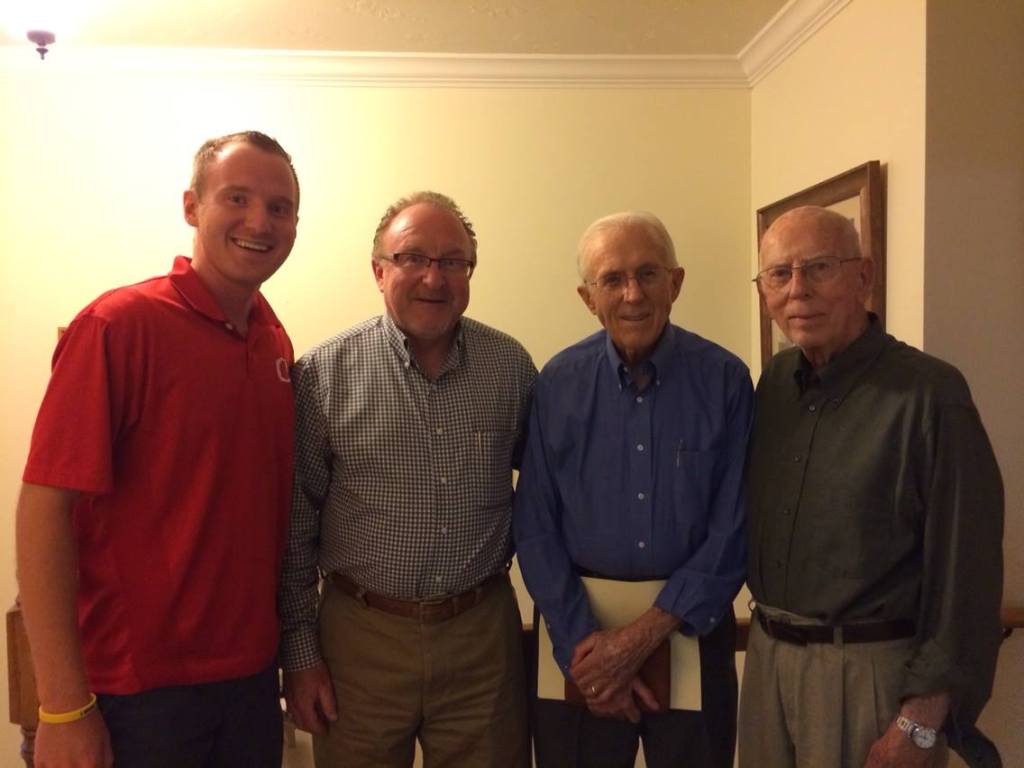
Photo taken September 1, 2014.
Elder Corbridge, in the same talk I mentioned earlier, addresses the principle of truth that is integral to furthering our understanding of the life and context of Joseph Smith and other aspects of church history that we may not understand at first:
“Opposition, criticism, and antagonism are companions to the truth. Whenever the truth with regard to the purpose and destiny of man is revealed, there will always be a force to oppose it. Beginning with Adam and Eve in the Garden of Eden, down to the ministry of Christ, and on down to our day, there has always been and will ever be an effort to deceive, derail, oppose, and frustrate the plan of life.
“Look for the biggest dust cloud billowing above the most dirt that is kicked at One who was most opposed, challenged, and rejected, beaten, abandoned, and crucified, One who descended below all things, and there you will find the truth, the Son of God, the Savior of all mankind. Why did they not leave Him alone?
“Why? Because He is the truth, and the truth will always be opposed.
“And then look for one who brought forth another testament of Jesus Christ and other scripture, look for one who was the instrument by which the fulness of the gospel and the Church of Jesus Christ were restored to the earth, look for him and expect to find the dirt flying. Why not leave him alone?
“Why? Because he taught the truth, and the truth will always be opposed.
“There is no dispute about what Joseph Smith accomplished, only how he did what he did and why. And there are not many options. He was either pretender or prophet. Either he did what he did alone, or he had the help of heaven. Look at the evidence, but look at all of the evidence, the entire mosaic of his life, not any single piece. Most importantly, do as young Joseph and ‘ask … God, that giveth to all men liberally, and upbraideth not; and it shall be given [you].’12 This is not only how you may learn the truth about the Book of Mormon and Joseph Smith; it is also the pattern to know the truth of all things.”13
I testify that what Elder Corbridge taught is the truth. Fundamentally, the story of the restored Church is the story of the Christ. I would love to expand on that suggestion, but for the sake of time I will have to leave it at that. I invite you all to revisit Elder Corbridge’s talk.
As I conclude my remarks, I want to do so by emphasizing and testifying that the truth has been restored and it is available to anyone who seeks it. There are a lot of questions being asked, which is a great thing, and there are a lot of answers as well. There is a prophet on the earth today, the rightful successor and the holder of the keys to the Kingdom, that leads and directs this Church under the divine direction and according to the will of the Lord, and as he said recently at his devotional address at BYU, which all of you should see, “truth is truth,” and we may know for ourselves what is truth and what is not.14 We who are blessed to know it should share it, and those who have yet to know it should seek it. I love the candor and testimony of Elder M. Russell Ballard of the Quorum of the Twelve Apostles that he shared on a recent visit back east to visit the birthplace of Joseph Smith. In a video released by the Church News following the trip, he said:
“I’ve got the bust of Joseph F. Smith and Joseph and Hyrum, and I look at them and I think I hear them say, ‘Get going boy and do something worthwhile. Tell the world what’s happened.’ So to me, I get nudged big time when I see them and see what they did and what they gave. Then I feel obligated to do everything I can to declare and to teach that the fulness of the gospel of Jesus Christ is once again upon the earth. And that’s because…on December 23, 1805, a little boy was born named Joseph.”15
I have talked about a lot of things today, but if nothing else of value was said, I hope that I am at least able to communicate my testimony that Joseph Smith was and is a prophet of God and the prophet of the restoration. Through an imperfect and vulnerable human being, Jesus Christ was able to restore the truth to the world, and that restoration continues to this day and shows no signs of stopping. I offer my praises to the man who communed with Jehovah, and echo the joyous voices that sing the words of the hymn:
“Sacrifice brings forth the blessings of heaven; Earth must atone for the blood of that man. Wake up the world for the conflict of justice. Millions shall know ‘Brother Joseph’ again.”16
That every one of us count ourselves one of them is my prayer. In the name of Jesus Christ, amen.
References
- Joseph Smith History 1:33
- Corbridge, Lawrence E. “The Prophet Joseph Smith,” Ensign, May, 2014, 103.
- Smith, Joseph. “The Wentworth Letter,” Ensign, July, 2002.
- John 8:32
- James 1:5
- Pace, Glenn L. “Follow the Prophet,” Ensign, May, 1989, 26.
- Joseph Smith History 1:1, 5-6, 8-10, 13-17
- Bitton, Davis. “I Don’t Have a Testimony of the History of the Church,” 2004 FairMormon Conference. https://www.fairlatterdaysaints.org/conference/august-2004/i-dont-have-a-testimony-of-the-history-of-the-church
- ‘Triple combination’ is the colloquial reference to the single volume collection of scripture containing the Book of Mormon, the Doctrine and Covenants, and the Pearl of Great Price.
- Doctrine and Covenants 21:1-6
- Matthew 16:18
- James 1:5
- Corbridge, Lawrence E. “The Prophet Joseph Smith,” Ensign, May, 2014, 104.
- Nelson, Russell M. “The Love and Laws of God,” devotional address given at Brigham Young University on September 17, 2019. https://speeches.byu.edu/talks/russell-m-nelson/love-laws-god/
- “Birthplace of a Prophet | President Ballard, Elder Christofferson testify,” https://youtu.be/Ipy7vJ_9OS4?t=107
- Hymns, 27.
 Dillon Boss