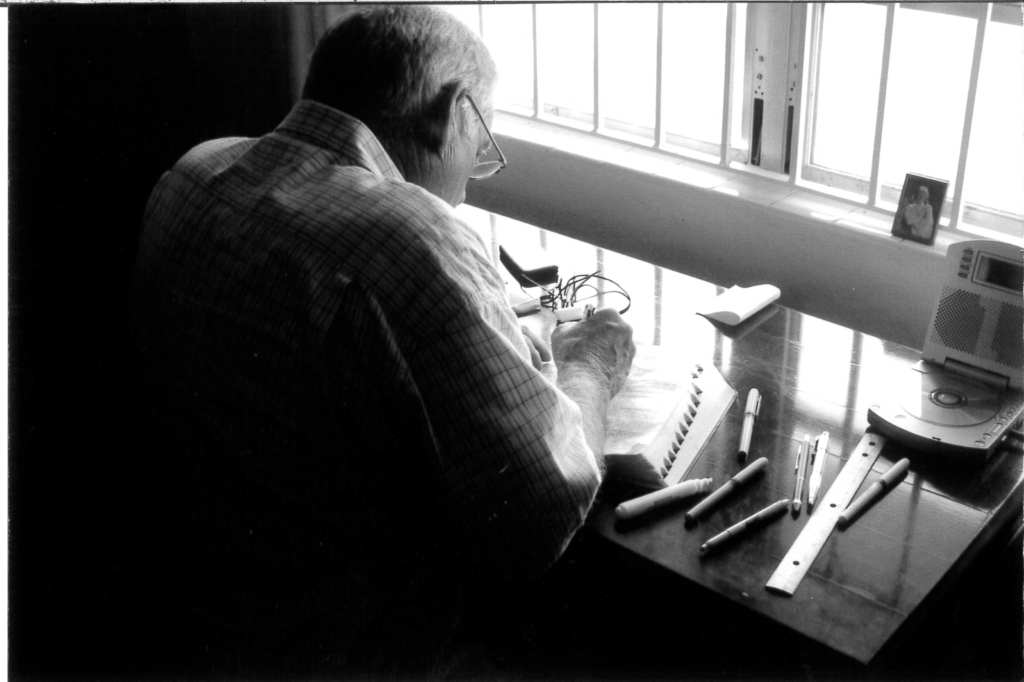
This talk was given at the memorial service for Gary P Washburn held at the Warenski Funeral Home in American Fork, Utah, on Thursday, April 27, 2023. The talk is titled Power in the Word, Power in the Plan.
Early in 2012, I was called on a mission for the Church of Jesus Christ of Latter-day Saints and assigned to labor in Chile. As exciting as it was at the beginning, the many weeks and several months I had to wait and prepare for my departure were filled with anxiety and self-doubt. It wasn’t the leaving home part; I had lived away at college for a little while. It wasn’t a lack of knowledge or faith; I had attended church all my life and truly believed in God. It wasn’t the strangeness of a foreign country per se; I had visited other countries before. Rather, the biggest fear and nearly debilitating trepidation I had that seemed to never leave me alone was the thought of learning Spanish. The thought of going to a faraway place and being solely responsible for communicating fluently in a foreign tongue was beyond daunting. I had performed terribly in my Spanish classes in high school, earning poor grades and experiencing many traumatic failures. I simply did not feel up to the task, and few things provided me peace. Until one day I visited Grandpa.
Many of you were probably acquainted with one of Gary’s many home offices or study rooms he maintained in each of their homes. At least in the homes Grandpa and Grandma have had over the course of my 30 years, it seems like he always had a special room that housed the same collection of obscure memorabilia, photo prints tacked to the wall, odd native American lore, and that stuffed pheasant whose origin I’m not sure any of us really know. Grandpa always had plenty of seating in these offices, like a couch or some wingback chairs — places where people could sit and visit and stay awhile. In these rooms, he also had a desk. And at that desk he would study. As he aged, the hours he would spend in study grew longer, earlier, and later. In their home on 1590 West in Pleasant Grove, which is most familiar to me and many other friends and neighbors with us here today, for more than a decade Gary could often be seen through his office window by passing drivers and neighbors on walks, where the glow of the desk lamp in a dark room illuminated the stark whiteness of Grandpa’s hair, his white shirt (often just a garment top), and the pages of his scriptures. However you knew Gary in this life, on his best behavior or his worst, that Gary in the window is a Gary worth remembering. I sincerely believe that if God turns boys into men and men into leaders through “the refiner’s fire and fullers’ soap” as we read in Malachi,1 Gary’s transformation happened as he immersed himself in the scriptures.
But back to the story. I entered that office one sunny afternoon in the spring of 2012, with a heart as heavy as ever, like I mentioned over the triviality of my Spanish conundrum. “Heya Grandpa!” I probably said as a plopped down on the couch there adjacent to his desk. We exchanged the usual updates. He probably then asked me how I was really doing, and unable to protect myself from Grandpa’s wise perceptiveness, especially when it came to spiritual matters, I recall explaining to him my worries and fears about heading off to preach the gospel far away for two years, and especially my concerns about learning Spanish. If he said something to me at that time, I don’t remember it. But I do remember what he did next. He picked up his large triple combination of the Book of Mormon, the Doctrine and Covenants, and the Pearl of Great Price, and thumbed through the wrinkled pages many of you remember were customarily and scrupulously marked and annotated until he arrived at a scripture in the Doctrine and Covenants. He must have handed me the book and prompted me to read, because I recall hefting it and starting to read aloud. These are the verses that I read:
2 And, behold, and lo, this is an ensample unto all those who were ordained unto this priesthood, whose mission is appointed unto them to go forth—
3 And this is the ensample unto them, that they shall speak as they are moved upon by the Holy Ghost.
4 And whatsoever they shall speak when moved upon by the Holy Ghost shall be scripture, shall be the will of the Lord, shall be the mind of the Lord, shall be the word of the Lord, shall be the voice of the Lord, and the power of God unto salvation.
5 Behold, this is the promise of the Lord unto you, O ye my servants.
6 Wherefore, be of good cheer, and do not fear…
(This is about when I became so emotional that I could not finish the passage. I was overwhelmed. Grandpa must have asked if I would like him to finish reading it, because I remember sheepishly handing back the open book.)
…for I the Lord am with you,” Grandpa read, “and will stand by you; and ye shall bear record of me, even Jesus Christ, that I am the Son of the living God, that I was, that I am, and that I am to come.”2
These verses were a balm for me — like pure revelation in that moment, as though the voice of the Lord was directed right at me just as it had been in the historical context of those verses to Orson Hyde through the prophet Joseph Smith in 1831. I heard the voice of the Lord through my grandfather that day, and it remains one of if not the most pivotal of experiences I have had with the Lord in the scriptures. I learned that day, if I had not known it before, that in the Word there is power. And I trust that all of you would agree that that was probably Grandpa’s most enduring sermon. He loved God and he loved the word of God. To make a short story longer, a few weeks after that experience in Grandpa’s office that day, I embarked on that mission and served as valiantly as I could for two years and ended up learning Spanish with native fluency. And I did strive to bear record of Him, even Jesus Christ, and if I fell short, it was that experience with Grandpa that often sustained me. That is the Gary Washburn I remember.
The message that Grandpa wished could be shared on this occasion is one centered on Christ, His Atonement, and our Heavenly Father’s eternal plan. A lofty topic indeed, and I don’t have a lot of time, but I want to highlight some key principles Gary believed that make seeing him off on his next journey such a joyous experience even despite his loss. I turn now to the prophet Jacob in the Book of Mormon.
6 For as death hath passed upon all men, to fulfil the merciful plan of the great Creator, there must needs be a power of resurrection, and the resurrection must needs come unto man by reason of the fall; and the fall came by reason of transgression; and because man became fallen they were cut off from the presence of the Lord.
7 Wherefore, it must needs be an infinite atonement—save it should be an infinite atonement this corruption could not put on incorruption. Wherefore, the first judgment which came upon man must needs have remained to an endless duration. And if so, this flesh must have laid down to rot and to crumble to its mother earth, to rise no more.
8 O the wisdom of God, his mercy and grace! For behold, if the flesh should rise no more our spirits must become subject to that angel who fell from before the presence of the Eternal God, and became the devil, to rise no more.
10 O how great the goodness of our God, who prepareth a way for our escape from the grasp of this awful monster; yea, that monster, death and hell, which I call the death of the body, and also the death of the spirit.
11 And because of the way of deliverance of our God, the Holy One of Israel, this death, of which I have spoken, which is the temporal, shall deliver up its dead; which death is the grave.
13 O how great the plan of our God! For on the other hand, the paradise of God must deliver up the spirits of the righteous, and the grave deliver up the body of the righteous; and the spirit and the body is restored to itself again, and all men become incorruptible, and immortal, and they are living souls, having a perfect knowledge like unto us in the flesh, save it be that our knowledge shall be perfect.3
These scriptures and others teach us that according to God’s plan we are born, we live, and we die in a corruptible state full of disease and sin that distances ourselves from Him. But this plan is not a plan of condemnation, but a plan of redemption. God’s is not a plan of sadness, but a plan of happiness, where a Lord and Savior atones for these ills to redeem us and give us life in death.
16 And thus mercy can satisfy the demands of justice, and encircles them in the arms of safety….4
Jesus Christ is that Redeemer, and only in Him and through His sacrifice do we overcome that certain death, as Jacob taught. The Savior said in his resurrected glory,
10 Behold, I am Jesus Christ, whom the prophets testified shall come into the world.
11 And behold, I am the light and the life of the world; and I have drunk out of that bitter cup which the Father hath given me, and have glorified the Father in taking upon me the sins of the world, in the which I have suffered the will of the Father in all things from the beginning.
14 Arise and come forth unto me, that ye may thrust your hands into my side, and also that ye may feel the prints of the nails in my hands and in my feet, that ye may know that I am the God of Israel, and the God of the whole dearth, and have been slain for the sins of the world.5
16 For God so loved the world, that he gave his only begotten Son, that whosoever believeth in him should not perish, but have everlasting life.
17 For God sent not his Son into the world to condemn the world; but that the world through him might be saved.6
55 O death, where is thy sting? O grave, where is thy victory?
57 But thanks be to God, which giveth us the victory through our Lord Jesus Christ.”7
This is the fruit of His Gospel, that we rejoice in our redemption and in the life to come, which brings us peace. I feel that peace and I feel that joy. Then-Elder Russell M. Nelson said in a General Conference address in April 1992 that, “We can’t fully appreciate joyful reunions later without tearful separations now. The only way to take sorrow out of death is to take love out of life. …Our limited perspective would be enlarged if we could witness the reunion on the other side of the veil, when doors of death open to those returning home. Such was the vision of the psalmist who wrote, ‘Precious in the sight of the Lord is the death of his saints.’”8 9
In conclusion, I have one final, parting thought. If Grandpa’s sermon was power in the Word, then his joy was in the strength of his family. Gary’s family was the end all, and as we have remembered and enjoyed hearing about today with Jenell’s thoughtful comments, so much of what Grandpa did and lived for was us. Whether kin by blood or by neighborly association, Grandpa’s net was cast wide. He knew and we knew that his love for us was foremost, and we were better for it. President Nelson reminded in another conference address in 2001 that “material possessions and honors of the world do not endure. But your union as…family can. The only duration of family life that satisfies the loftiest longings of the human soul is forever…Our family is the focus of our greatest work and joy in this life; so will it be throughout all eternity….”10 This is the purpose of God’s plan. That we as families live forever in our joy. Gary knew it, and I know it.
There is movie, one I would call a family favorite, called Big Fish. This movie is about a storyteller, his life story, and his son seeking desperately to know the truth as his aging father’s health is declining. They’re at the hospital, and the father is dying — his son by his side. “The river” the ailing father says in a sudden moment of consciousness, and he asks his son, who is not a storyteller, to tell him how it ends. The son doesn’t know what to say; for the first time he does not know the end of his father’s story. So he proceeds to make it up. In his story, his father is suddenly sprightly, and they dash from the hospital and find his old red Dodge Charger in the parking lot in mint condition. They speed through the town into the countryside, where they get to the bank of the river. “As we get close to the river” his son tells, his father riveted on his every word, “we see that everybody is already there.” “He’s here!” someone shouts from the crowd as the son carries him down the embankment. “And I mean…everyone. It’s unbelievable!” the son exclaims, while we envision him carrying his father through the multitudes of all the characters of his life story — standing in ovation and bidding him a joyous farewell. “The story of my life” the father says with a look of satisfaction, like he approved of the story he was hearing. “And the strange thing is” the son continues, “there’s not a sad face to be found —everyone is just so glad to see you and send you off right.” The son then carries his father into the river and wades up to his waist. He lowers his father down. “You become what you always were—” he says thoughtfully. “A very big fish.”
Last Friday, I received a call from my sister with some news I only half expected, and an urging to come be with Grandpa as his final days turned to hours. When I arrived, everyone was there. I went to his bedside, and I took him by the hand and said, “I’m here, Grandpa.” Once again, we exchanged the usual updates, though this time a little more labored. Everyone came in and we gave him a blessing. Everyone was there. Later that evening he faded, and the next day lay calmly breathing slowly. It was early Sunday morning that he, in the words of a poet, “slipped the surly bonds of Earth,” and my brother was there with him when he passed. You often hear of people passing away surrounded by family. I learned this last week that that privilege need not be literal. For we were all there that day, as we stood on the metaphorical riverbank, “not a sad face to be found—everyone…just so glad to see [him] and send [him] off right.” And though he passed in the night with just one of us there at vigil, he passed surrounded by family — a well-deserved departure. For it is my vision of a joyous reunion on the other side, where Gary Washburn, our very own ‘Big Fish,’ emerged from the water to be greeted by the hosts of friends and family — his mother and father, a brother, best friends, and the angels that surround them to welcome him home.
This is the plan of happiness. And though the details of the hereafter remain shrouded by the veil, what Grandpa knew and what I know is that there is happiness in faith and righteousness. What Grandpa knew and what I know is that there is power in the Word and the teachings of God. What Grandpa knew and what I know is that there is joy in family and the closeness and eternity of our kin. What Grandpa knew and what I know is that there is peace in the Savior, who we know and love dearly, in whom all is made possible, and all are made free. Gary Washburn believed this, and we believe it too. And that is the message of this joyous memorial. In the name of Jesus Christ, amen.
References
- Malachi 3:2
- Doctrine and Covenants 68:2-6
- 2 Nephi 9:6-8, 10-11, 13
- Alma 34:16
- 3 Nephi 11:10-11, 14
- John 3:16-17
- 1 Corinthians 15:55, 57
- Psalms 116:15
- Nelson, Russell M. “Doors of Death,” Ensign, May, 1992, 72.
- Nelson, Russell M. “Set in Order Thy House,” Ensign, November, 2001, 71.
 Dillon Boss