Today it was suggested that we share some remarks about the Law of Sacrifice — certainly a lofty and intimidating topic worthy of serious reverence and contemplation. But to better understand the power, doctrine, and covenant associated with the Law of Sacrifice as contained in the Holy Scriptures, I will safely defer to the instruction offered in the Endowment ceremony in the temple (especially after the recent changes in the format of the presentation). So, for our purposes today, and with the very short amount of time we have, I will take a slightly different angle and attempt to talk about what sacrifice and its challenges can actually look like in the life of a Latter-day Saint.
We recently moved from the capitol hill area of Salt Lake City — the original Salt Lake stake. In the Salt Lake stake, it is common to have visits from General Authorities (two apostles live in that stake), as well as other influential members of the Church in the form of firesides, talks, and other events both formal and informal. The current president of the Salt Lake stake, Doug Wilks, who works as managing editor of the Deseret News, is known to invite friends and members of his vast network to stake events — something Sarah and I took every opportunity to benefit from. One particular occasion was especially memorable.
In an adult session of stake conference a few years ago, Sister Sarah Jane Weaver, editor of the Deseret News-affiliated Church News, was invited as a special guest speaker to share some of the most impactful experiences from her career traveling the world and reporting on Church activities. Among many stories about things like the ministries of the presidents of the Church and global humanitarian efforts, Sister Weaver shared the following story, which had been published in the Church News back in 2020, but which I had not before read. The following words are hers, with minor edits and adjustments to tenses for clarity:
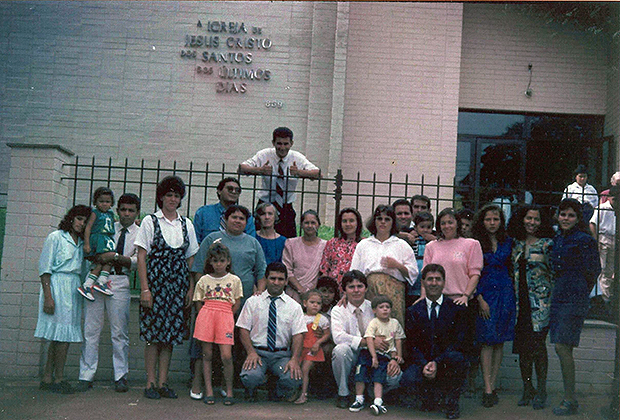
“I traveled to Manaus [Brazil] in June 2012, to cover the dedication of the Manaus Brazil temple. While there, I joined Flávio and Kenia Brito in the lobby of the Manaus temple patron housing for family home evening. Before we began, I helped their 10-year-old son Nefi practice his English. When the conversation turned to temples, I began to list all the temples near my home in the Salt Lake valley. There’s the Salt Lake temple, the Jordan River temple, the Oquirrh Mountain temple, and the Draper temple, I said [a list now joined by the Taylorsville temple]. Then I told Nefi about beautiful temples [nearby] in Bountiful, American Fork, Provo, and Ogden [a list now joined by temples in Layton, Syracuse, Payson, Provo City Center, Orem, Lindon, Saratoga Springs, and the Tooele valley]. I intended to list all the temples in the state of Utah, but Nefi interrupted. ‘Oh, Sister,’ he said. ‘How do you sacrifice?’ The question stilled me. I didn’t have an answer.
“There, in the heart of the Amazon River Basin —a place defined by faith-sustaining testimonies more powerful than the life-sustaining Amazon River— a child had grown up with the understanding that temple work and sacrifice were interdependent…. I came home from Manaus vowing to appreciate the temple more, to attend more often. But then life happened. We raced to and from the temple, rarely thinking of the blessings that flowed to us from those sacred experiences.
“Then, as COVID-19 intensified [in March of 2020], my daughter —preparing for missionary service— made an appointment to receive her living ordinances in the Draper Utah temple. At that time, temple ordinances were limited to only those doing work for themselves and their families [as guests]. When she told me the appointment was on a Thursday morning in late March, I hesitated. ‘Thursdays are very busy days for me,’ I said, ‘but I will make it work.’
“The night before she was to enter the temple, however, the First Presidency announced the closure of all temples worldwide. She was devastated. So were we. Her temple bag [then] sat in her room — ready to be used…. She started online MTC at home [some months later]. And when the First Presidency announced that temples would open again for living ordinances, she did not hesitate. She received a new appointment —once again on a Thursday morning— to enter the temple, and she entered the temple just days before leaving for her mission assignment. This time, a Thursday appointment did not give me hesitation or pause. During the COVID-19 pandemic, I learned that entering the temple is a great blessing — not something I have to fit into my schedule or to work around. I think today I would talk to Nefi Brito and the other faithful Saints I met in Manaus a little differently.
“Nazaré Negreiros, for example, was with a group of Latter-day Saints on a caravan from Manaus to the São Paulo Brazil temple in 2001 when the bus was assaulted by robbers. The bandits stole the Latter-day Saints’ money, cameras, and cell phones. The Saints arrived in São Paulo with nothing. A few years later, Nazaré’s son and daughter-in-law, Alexandre and Claudia Negreiros, were in a bus accident with other Church members while returning from the temple in Caracas [Venezuela]. Claudia was paralyzed from the neck down. One evening during my trip to Manaus, I sat with Nazaré. As we spoke, I asked her if she was discouraged by their temple journeys. ‘Do you feel like the Lord should have blessed you and protected you since you were going to the temple?’ I asked. Nazaré did not like the question. She shook her finger at me: ‘No one ever said that’ she said…. Then, trying to help me understand, she added, ‘We were happy. We had reached the temple.’
“As the years have passed since that exchange, I have tried to understand what Nazaré was trying to teach me. I think she was saying that each of us —Nefi, my daughter, and Claudia included— are walking the same covenant path. It is a journey —in good times or hard times— that requires both faith and commitment. It starts where we are and leads to the temple. It is the opportunity for each of us to answer a most important question: ‘How do you sacrifice?’”1
So what does that mean for us? Sarah and I also had a similar experience as Sister Weaver’s daughter, when the temples closed worldwide the night before we were scheduled to be sealed on March 26, 2020. And like Sister Weaver’s daughter, and so many other devout Latter-day Saints in our situation, we did not hesitate when temples cautiously resumed operations soon after. We were sealed in the Manti Utah temple —the first to open amid strict COVID-related restrictions— not two months later on Memorial Day weekend in 2020. No party. No reception. No wedding gown or fancy suits. We were waiting on the Lord. And I can confidently see the promise in Isaiah fulfilled that “…they that wait upon the Lord shall renew their strength; they shall mount up with wings as eagles; they shall run, and not be weary; and they shall walk, and not faint.”2
So, I ask you, in a time of prosperity that each one of us so indisputably enjoys, when temple spires can be spotted from practically every window; when hard-earned restored truth and the religious freedom to live it without fear of physical persecution abound at minimal cost to us in the present day; when technology facilitates with ease the most complex of tasks and travel; in a world that is faster, cheaper, and more convenient than ever before in history; again I ask, how do you sacrifice?
I could never claim the answer to that question for anyone, not even myself most of the time, and each of us bears burdens that the other will never know. But I will share one truth that I do know and that we should all know.
14 And behold, this is the whole meaning of the law, every whit pointing to that great and last sacrifice; and that great and last sacrifice will be the Son of God, yea, infinite and eternal.3
As then-Elder Dallin H. Oaks taught, “Jesus Christ endured incomprehensible suffering to make Himself a sacrifice for the sins of all. That sacrifice offered the ultimate good—the pure Lamb without blemish—for the ultimate measure of evil—the sins of the entire world.”4
Striving to understand and make real the supernal sacrifice of Jesus Christ in our lives can inform and inspire our desire to know how we can sacrifice in sustaining and defending the Kingdom of God in these latter days. Let us repent, engage the Spirit in our service and ministering, make time for the Lord, fall on our knees in gratitude daily, and acknowledge our nothingness lest we think ourselves greater. I pray that each of us, as we seek, will come to know for ourselves the answer when we sincerely ask the Lord, “How can I sacrifice?” In the name of Jesus Christ, Amen.
References
- Weaver, Sarah Jane. “Sarah Jane Weaver: What I learned from a child in Manaus about temples, faith and sacrifice.” Church News, August 31, 2020.
- Isaiah 40:31
- Alma 34:14
- Oaks, Dallin H. “Sacrifice,” Ensign, May, 2012, 19.
 Dillon Boss