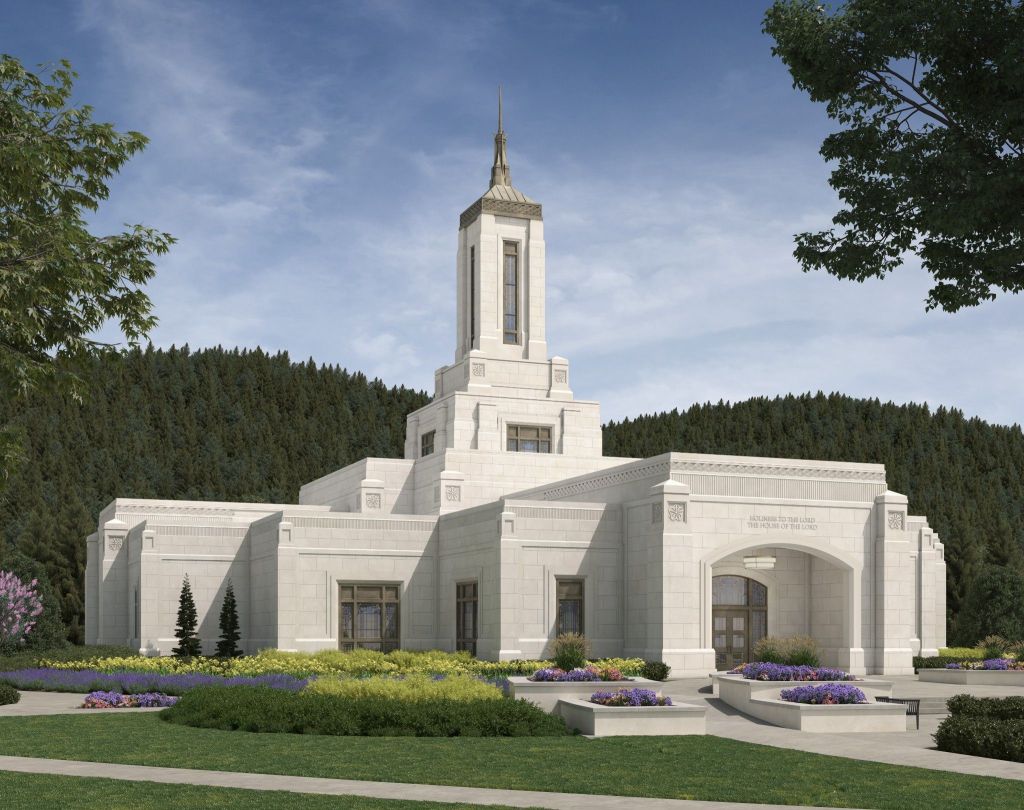
On a recent trip through Oregon, my wife and I took the opportunity to visit the Willamette Valley temple construction site in Springfield. I was born and spent the first number of years of my life in Springfield and Eugene, and we were visiting the area on a trip down memory lane. With the exciting announcement by President Russell M. Nelson in April 2021 of a temple to be built in Eugene, we were anxious to check on the progress and get a better feel for the setting of the temple in relation to other landmarks in the area. We learned that when the temple site was actually revealed to be in the neighboring city of Springfield and not in Eugene, the name ‘Willamette Valley’ was proposed for the temple so as to be more representative of the greater area rather than a city in particular.
Anticipating only a generic construction site, we were pleasantly surprised to encounter a visitors center (which was actually just a portable trailer with some chairs inside and some art on the walls). Staffing the visitors center was a senior missionary couple named Elder and Sister Hachtel, who had been called on a mission and assigned to the Willamette Valley Temple site to keep a history of the temple construction — an assignment they take very seriously. We were fortunate to talk to them for a few minutes about their experiences so far (they don’t get too many visitors) and even watch a presentation they had prepared with lots of information about the area, the temple, and the construction process in general. The Hachtels had story after story about the coming about of the Willamette Valley Temple, all of which strengthened our faith, invited us to feel the Spirit, and demonstrated the hand of the Lord in the construction of His holy houses. I will share one of them here, one that I made sure to get permission to tell.
The Willamette Valley Temple site is located in a very nice business park-like area with multi-use zoning. There is a hospital nearby, and several small office buildings. It is an impeccably landscaped area backing up to the McKenzie River and a picturesque tree-covered hillside. It is as ideal a setting as we have come to expect from the Church for the building of a temple. The temple site is actually comprised of three different building lots that the Church acquired back in the Great Recession of 2008–2009 (there were originally four lots, but one of them was sold a few years ago). So even though the Church has owned the land for many years, it was not until recently that steps were taken to build something. For this reason, Church building officials were somewhat surprised when they learned that the proposed site for the temple had strict zoning restrictions for buildings of a religious nature. No churches allowed. This posed an obvious impediment to future construction efforts for a religious temple, so representatives of the Church were dispatched from Salt Lake City to Springfield to inquire about what might be done.
Operating ‘incognito’ so as to not reveal the identity of the Church and its interests (this is a common practice in high-profile real estate projects), representatives of the Church arrived in Springfield with meetings scheduled with a prominent real estate attorney with hopes of finding a way forward. The day of the scheduled meeting, the attorney with which they were hoping to meet was not available and sent an associate instead. Perhaps feeling like their chances of getting the expert legal counsel they bargained for had been slighted, they agreed to meet with the associate. Without revealing the identity of the Church, the representatives from Salt Lake explained the situation about the zoning restrictions and that the intended use of the proposed building was, in fact, religious. “Do you happen to be from The Church of Jesus Christ of Latter-day Saints?” the attorney asked. Taken aback, the representatives from Salt Lake confirmed that they were (I assume that since they were asked outright, to deny it would have been dishonest, so the proverbial cat was out of the bag at that point). Come to find out, that associate attorney meeting with them that day was a bishop in one of the stakes in the Willamette Valley Temple district. He told them that he had contacts on the Springfield zoning commission he worked with regularly and he would do everything he could to get the matter resolved so temple construction could proceed.
As the Church’s officially-appointed legal counsel for the Willamette Valley Temple project, this good bishop approached a contact on the zoning commission and laid out the problem with the restrictions. To his complete surprise, this was her response (paraphrased):
“In section 109 of the Doctrine and Covenants, it says that a temple is a ‘house of learning,’ right?”
“Well, yes. It does” the attorney replied.
“The zoning guidelines for the area do permit buildings for educational use,” said the zoning official. “So I don’t think it would be inappropriate to present the temple plan as a place of learning rather than a place of worship.”
As it turns out, the woman on the Springfield planning commission was a member of the Community of Christ (formerly known as the Reorganized Church of Jesus Christ of Latter-day Saints, or RLDS), a faith that esteems many of the sections of the Doctrine and Covenants as revealed to the prophet Joseph Smith as scripture in the same fashion The Church of Jesus Christ of Latter-day Saints does. Indeed, section 109 of the Doctrine in Covenants admonishes us to
8 Organize yourselves; prepare every needful thing, and establish a house, even a house of prayer, a house of fasting, a house of faith, a house of learning, a house of glory, a house of order, a house of God;
So that is precisely what Church architects did as they submitted plans for the temple for review. Rather than ‘endowment’ rooms, they were labeled as ‘instruction’ rooms, and rather than a place of ‘worship,’ the Willamette Valley temple was proposed as a place of ‘learning.’ The plans were approved, and construction officially began just weeks after the groundbreaking ceremony in October 2022.
Rather than analyzing the ethics of the Church’s legal jiujitsu, of which there are countless examples every year all around the world, I believe that the emphasis of this particular temple as a ‘house of learning’ sheds light on a profound truth that I had not completely considered before. Not in any way undermining a temple’s sacredness as a house of God and place of elevated worship set apart from our regular-use meetinghouses, framing the temple as a place of learning and instruction strengthens and reiterates the essence that attracts all of us to these sacred buildings. With this in mind, temples become not only places where we make sacred covenants, perform work for the dead, and seek guidance and direction in our lives by the Spirit, but a place to learn our divine origin, understand the role and mission of the Savior Jesus Christ, realize the influence of the Adversary in our world, comprehend the Plan of Salvation, determine what we must do to stay close to God, and even demonstrate the true order of prayer. All of these things not only complement the worship so inherent to temples and other sacred buildings (which again were not allowed per the zoning restrictions for that particular area in the city of Springfield), but they actually encompass it. As we are instructed and learn, we can grow closer to God knowing more of His ways and purposes for us. Endowment and instruction then go hand and hand, and I might even suggest that your endowment is instruction. You covenant with God to obey, and in exchange, you are given further light and knowledge that translates to power and confidence as you go about your everyday life. This is the power of instruction, and the Willamette Valley Temple will stand for generations to come as a symbol of that. If not in our hearts and minds, on the actual affidavits attached to the plans on file at the Springfield city offices.
Author’s note: I would be remiss not to mention the overwhelming spirit I felt at the temple site as I contemplated the generations of faithful families, missionaries, dedicated leaders, and all walks of Latter-day Saints that have played a part in the building up of Zion in Oregon and the ultimate construction of the Willamette Valley Temple. My grandfather was a member of the Eugene stake presidency for many years, a bishop several times over, and a leader and teacher in many other capacities over his long tenure of service making lengthy drives to remote branches to train and minister to the Saints in the Willamette Valley. My grandmother taught children in primary, accompanied them as they sang, and devoted years to family history research as she served faithfully alongside my grandfather and in her own unassuming ways. My father was a bishop in Springfield and was actively involved in the development of young men and future missionaries in the Boy Scouts. My mother was a leader and teacher of women and children and a stalwart at any activity or service assignment she was given. My siblings attended seminary, participated in youth activities, and formed the beginnings of their testimonies as they were taught by other devoted followers of Christ. My brother-in-law was a full-time missionary in the Eugene mission, spending two years riding bikes around, knocking doors, and sharing the message of the restored gospel with any willing ear. As I saw the foundation of the temple solidified in concrete and rebar, I realized that the real strength of the temple is not in its engineering, but in the faith and devotion of the members — past, present, and future. These and all of our experiences and sacrifice come into focus as we continually train our glance on the temple.
 Dillon Boss